

Blog
The Oversight—A Blog on CRO Selection, Operational Excellence, and Clinical Delivery
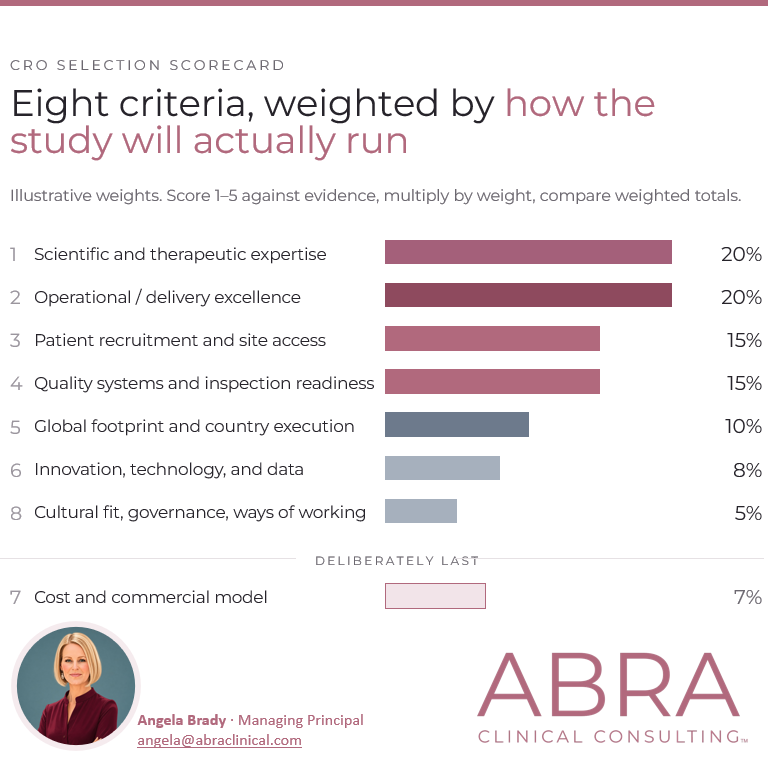
The CRO Selection Scorecard: A Practical Way to Choose the Right Partner
Choosing a CRO is a decision about how your clinical program will operate: how risks are identified, how sites are supported, how data and quality are managed, how quickly decisions are made, and whether the study can be delivered when the plan inevitably encounters reality.
That is why the “best” CRO is not automatically the largest, the most familiar, or the lowest-cost bidder.
The best CRO is the partner whose…
Leading a First Clinical Trial as a Sponsor Organization
A company's first clinical trial is typically a leadership problem disguised as an operational one. The operational elements can be outsourced. The sponsor responsibilities cannot.
The most common misunderstanding is the scope of what remains with the sponsor after a CRO is engaged. Regulatory accountability does not transfer. Oversight obligations…
Fractional COO vs. Full-Time Hire: Making the Right Call for Your Clinical Program
When a biotech company begins to move from discovery into clinical development, the leadership needs change quickly. Someone has to translate a scientific plan into an operational one, manage outside partners, and keep spending aligned with the capital runway. Many founders assume the only answer is a full-time Chief Operating Officer. Often, a fractional COO is the better first step.
Consider the math. A full-time COO with…
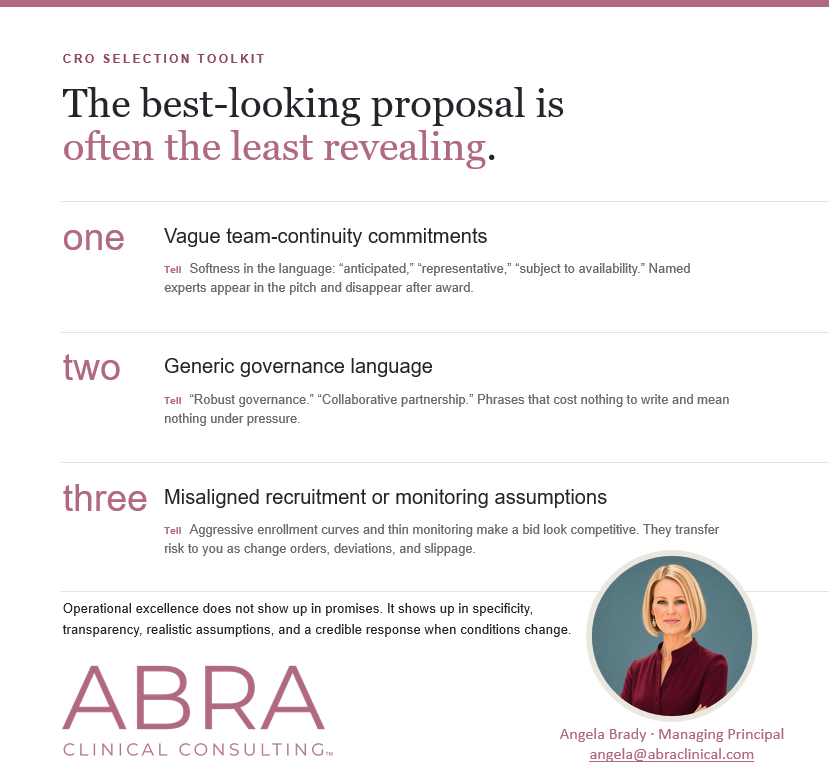
Three Red Flags in CRO Proposals That Predict Headaches Later
The best-looking proposal is often the least revealing.
A polished deck tells you how well a CRO sells. It doesn't tell you how that CRO will behave halfway through the projected timeline, when enrollment is 40% behind forecast, sites have stopped enrolling, and your data manager just flagged a query backlog you can't explain to your board.
The signals are already there. They're in the language the CRO uses.
Here are three I look for…
Financial Fluency for Clinical Research Leaders
Clinical operations leaders are routinely accountable for budgets they were never taught to read. The result is a predictable pattern: a study runs over, the overage is attributed to enrollment challenges or scope evolution, and nobody can reconstruct which decisions actually caused it.
Financial fluency for a clinical leader does not require accounting expertise, but it does require a working grasp of four things…

Selecting a CRO
A signed CRO contract is not an operating model.
In 25+ years across CRO leadership and helping sponsor operations, I kept seeing the same pattern: brilliant science, a committed team, a carefully chosen CRO…and momentum quietly leaking away because no one had built the operating system around the partnership.
It's never a lack of effort or intelligence. Emerging sponsors are…
Leading Through Risk-Based Quality Management
Risk-based quality management asks clinical leaders to do something genuinely difficult: decide where not to look. A framework that concentrates oversight on the data and processes most critical to participant safety and trial reliability necessarily reduces attention elsewhere. That is why RBQM implementations so often stall.
The stall usually takes a recognizable form. The organization adopts the framework, builds the risk assessment, defines key risk indicators, configures the platform, and then continues monitoring everything at close to the previous intensity because…
What Fractional Executive Leadership Means for Emerging Biotech Sponsors
Most emerging companies reach the same crossroads. The science is promising, the first-in-human study is on the horizon, and the board is asking who will own clinical execution. The answer is often nobody, at least not yet. Hiring a full-time Chief Operating Officer or VP of Clinical Operations can take six months and cost more than the company can justify before a financing milestone. That gap is exactly where fractional executive leadership earns its place.
A fractional executive is a seasoned leader who works with your company on a part-time or defined-scope basis. In clinical research, that usually means…
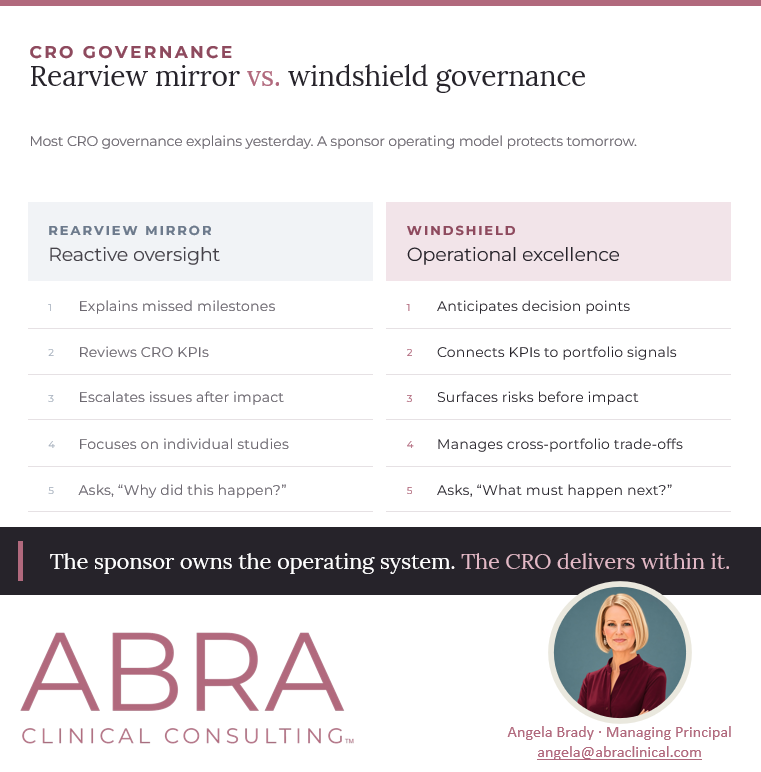
How Portfolio Governance and PMOs Should Interact With CROs
A CRO cannot outperform the sponsor operating model it's beholden to. That may be uncomfortable to say, but it is often true.
A CRO can have strong therapeutic expertise, an experienced study team, and sound processes and still struggle to deliver when biotech and emerging biopharma priorities shift without clarity, decisions stall, or internal capacity is invisible until it becomes a bottleneck.
CRO governance is typically…
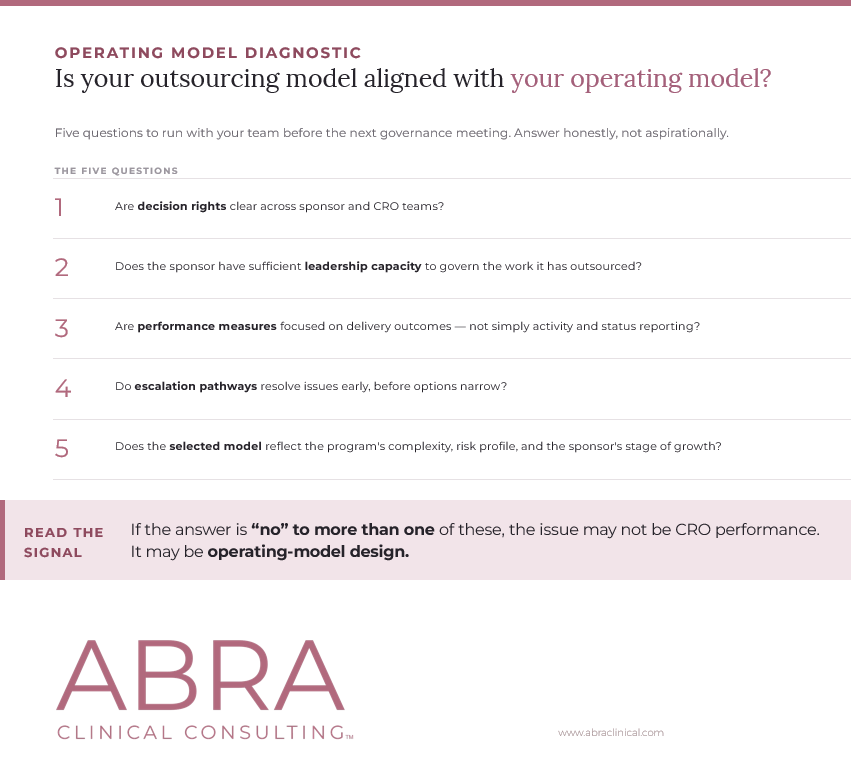
Outsourcing Model Choices: What Sponsors Often Get Wrong
The costliest CRO decision is often made before the CRO is chosen. It happens when a sponsor treats full-service, FSP, or hybrid outsourcing as a buying decision.
All three models can work. And all three can fail expensively.
A full-service CRO can bring integrated execution when sponsor capacity is lean. But it does not remove the sponsor’s responsibility to…
Building a CRO Management Function From Scratch
You can outsource execution. You cannot outsource accountability.
That distinction is where many CRO/sponsor partnerships succeed…or unravel.
For a small biotech, hiring a CRO can feel like acquiring a ready-made clinical operations organization, but a CRO is not a substitute for a sponsor-side operating model.
The sponsor still owns…
Competency Frameworks for Clinical Project Managers That Are Worth Building
Competency frameworks in clinical research tend toward two failure modes. They are either so generic they describe any manager in any industry, or so exhaustive that nobody reads them after the first assessment cycle.
A useful framework for clinical project managers is narrow, observable, and tied to actual study work. Five domains cover most of what matters.
Operational planning is the…
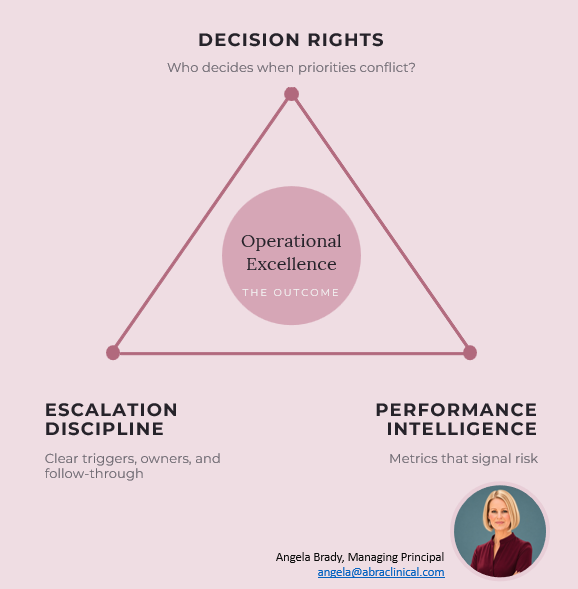
Governance is Your Real CRO Performance Management System
A well-written MSA and SOW do not manage CRO performance.
They establish the commercial and contractual foundation. But when timelines slip, enrollment assumptions change, site activation stalls, or a critical issue sits unresolved, the contract is rarely what determines the outcome.
Governance does.
Too many sponsors over-index on…
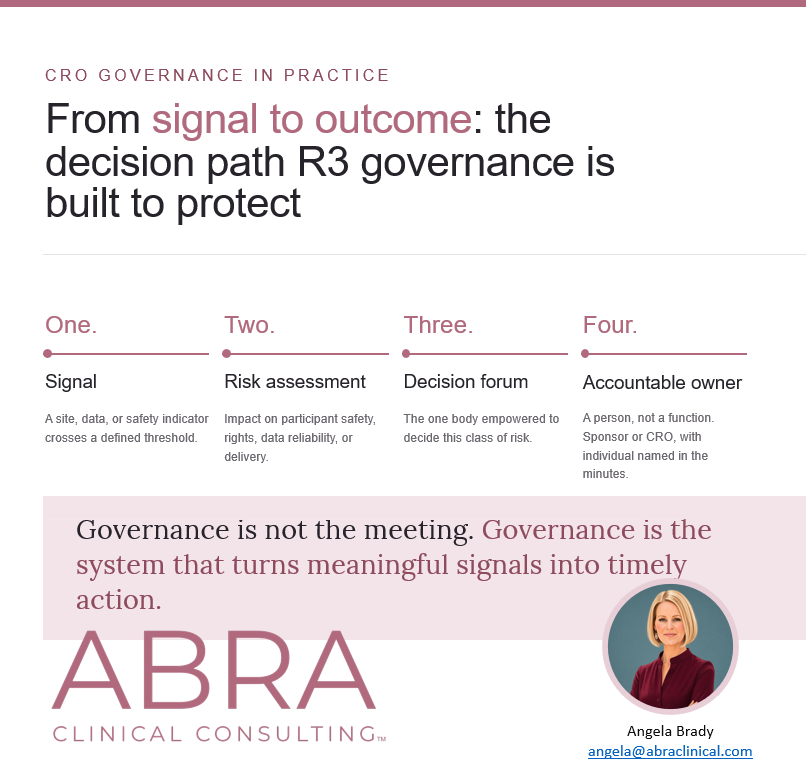
Operational Oversight or Compliance Theater
If your governance model produces 12 pages of meeting minutes, but no clear decision, owner, or change in course, it is not operational oversight. It might be compliance theater.
As organizations implement ICH E6(R3), I worry that some will respond as our industry often does to change: add another meeting, expand the checklist, build another dashboard, and document every discussion in greater detail.
But R3 is not a mandate to create…
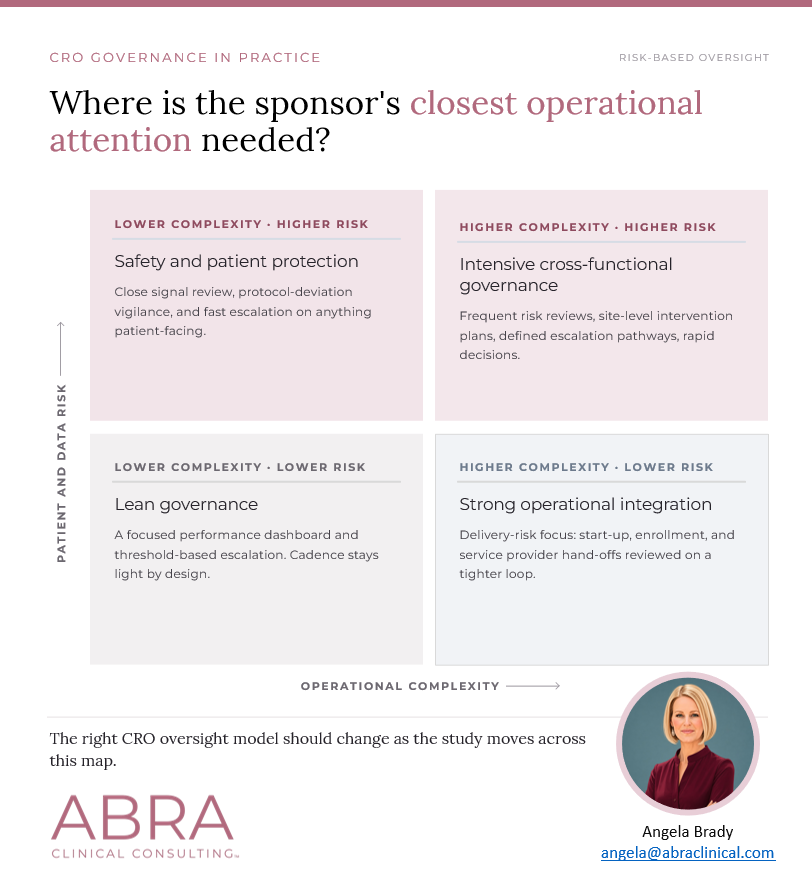
More Sponsor Oversight Does Not Automatically Create Better CRO Oversight
More sponsor oversight does not automatically create better CRO oversight or operational excellence.
In biotech, uncertainty often triggers more meetings, trackers, dashboards, action logs, and approval layers. It can feel like control. But it can also create administrative drag while the operational risks most likely to affect patients, data quality, timelines, and delivery receive the same attention as everything else.
A risk-based oversight model asks a more useful question…
Why Clinical Operations Talent Leaves, and What Leaders Control
Turnover in clinical operations, particularly among clinical research associates and clinical trial managers, remains a persistent constraint on delivery. It disrupts site relationships, erodes study knowledge, and imposes retraining costs that never appear cleanly in a budget line.
Compensation drives some of it and leaders control little of that directly. Several other drivers are within reach.
Workload opacity ranks…
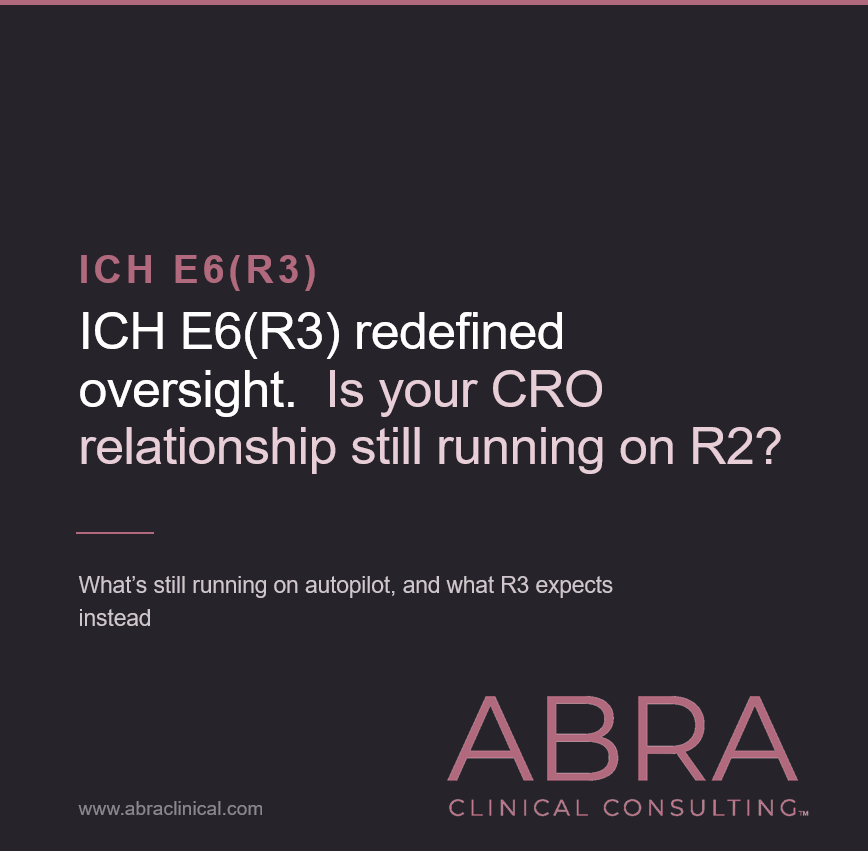
What ICH E6(R3) Really Means for CRO Selection and Vendor Oversight
Many biotech and emerging biopharma sponsors are treating ICH E6(R3) as a documentation update: new templates, new signatures, same relationship with the CRO underneath. That reading will not survive an inspection. R3 says accountability cannot be delegated. Whatever the CRO does, the sponsor still owns trial quality and participant safety, and a CRO's failure shows up as the sponsor's finding.
That changes three things that are currently on autopilot…
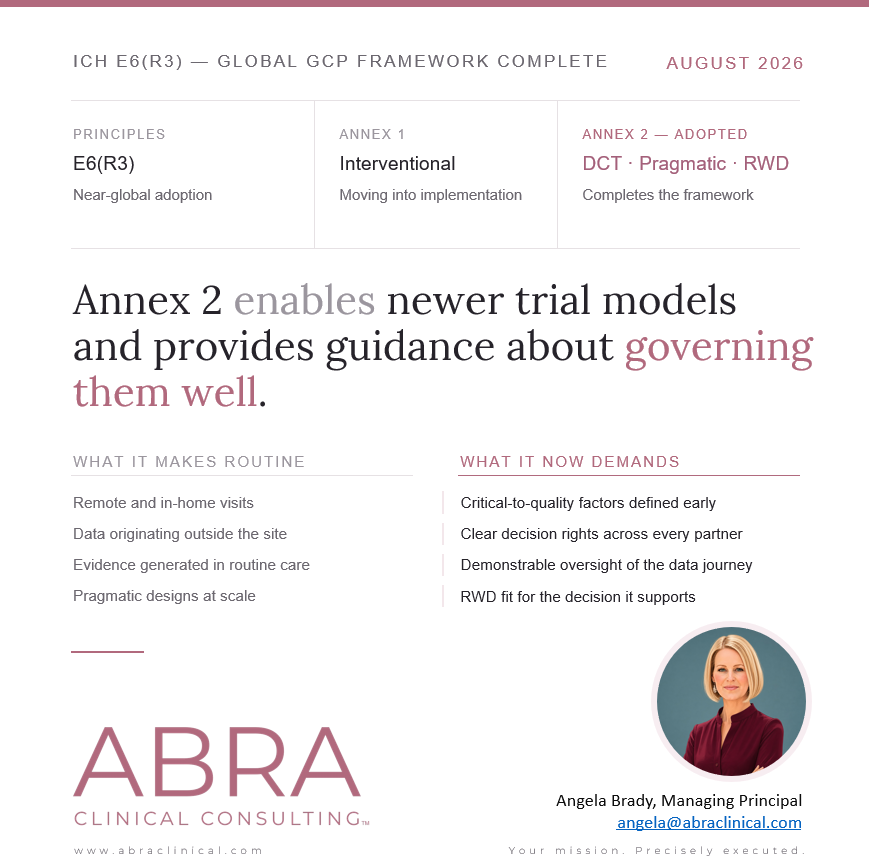
ICH E6(R3) GCP Annex 2
On June 3, 2026, the final ICH E6(R3) Good Clinical Practice Annex 2 was adopted and officially published by the International Council for Harmonisation.
With Annex 1 already moving into implementation, Annex 2 completes the updated global GCP framework. And for biotech and emerging biopharma, this is a signal that the operating model for clinical research must evolve…
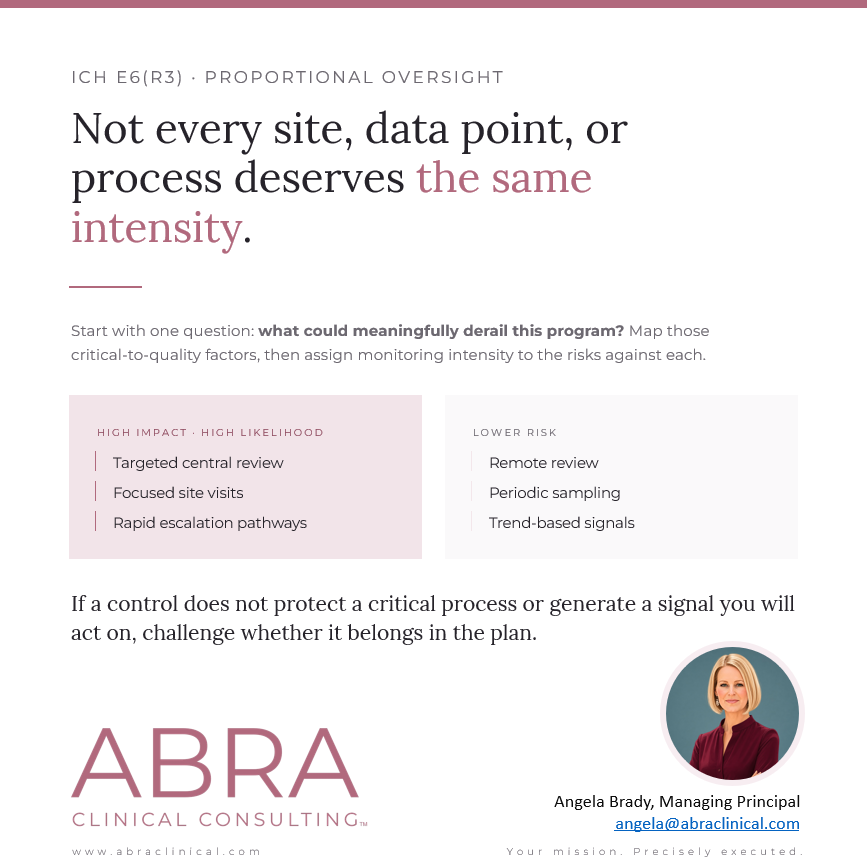
ICH E6(R3)’s Risk-Based Approach
For lean biotech and emerging biopharma teams, ICH E6(R3)’s risk-based approach is an invitation to spend deliberately. You do not need to monitor every site, data point, activity, and process with the same intensity. The goal is proportionality. To focus oversight where failure could genuinely compromise participant safety, rights, wellbeing, or the reliability of the data needed to make a development decision.
A proportional monitoring plan starts with…
What AI Changes About Clinical Project Leadership, and What It Does Not
Artificial intelligence is already reshaping parts of clinical operations. Site identification, enrollment forecasting, risk signal detection, document drafting, and query generation are all being automated or augmented. The question for clinical leaders is which parts of their role this touches.
The work that compresses is largely the synthesis and monitoring layer. Producing a status summary from multiple system exports, identifying outlier sites from monitoring data, drafting a first version of a study plan, and scanning for protocol deviation patterns are all tasks where a capable model plus a competent reviewer outperforms the manual process on speed and often on coverage. Leaders who spend…