
Blog
The Oversight
The Trial Master File Is a Story, Not a Storage Unit: AI and Inspection Readiness
AI is making Trial Master File management faster by automatically classifying, indexing and quality-checking documents. But a TMF that is perfectly filed can still fail an inspection. Inspectors are not only checking that documents exist. They are reading the TMF to reconstruct how the trial was conducted and whether decisions were sound.
The eTMF is a natural fit for automation. Documents arrive in huge volumes from many sources, and classification against the TMF Reference Model is…
Why Clinical Operations Leadership Gaps Put Your Development Timeline at Risk
Clinical trial delays rarely start with a dramatic failure. More often, they begin with small decisions that nobody clearly owns. A protocol amendment sits in review longer than it should. A site contract stalls. A CRO misses a milestone, and no one on the sponsor side has the experience to push back effectively. Each delay seems manageable on its own. Together, they can move a program's timeline by quarters.
The root cause is frequently a clinical operations leadership gap. Small sponsors often…
It’s NC Life Sciences Week!
NC Life Sciences Week has been a meaningful reminder that North Carolina’s life-sciences ecosystem is powered not only by scientific ambition, academic research, and innovation, but also by whether we design the work around the people it is intended to serve.
This week, I attended two complementary symposia:
At the 2026 Charlotte Regional Biomedical Science Symposium, the focus was on…
The Governance Gap Behind the EBP Boom
Emerging biopharma is driving more clinical trial starts than ever before. But too many programs are being asked to scale scientific ambition without the operational architecture required to carry it.
Emerging biopharma companies now account for 68% of all clinical trial starts, up from 56% in 2019. That is an extraordinary signal of…
Sponsor Leadership Behaviors That Shape CRO Performance
Sometimes a CRO performance problem is not actually a CRO problem.
When timelines slip, enrollment lags, data queries accumulate, or a critical issue arrives at a governance meeting already fully formed, the first question is often: Why isn’t the CRO performing?
That is a fair question. But it is rarely the only one worth asking...

The CRO Selection Scorecard: A Practical Way to Choose the Right Partner
Choosing a CRO is a decision about how your clinical program will operate: how risks are identified, how sites are supported, how data and quality are managed, how quickly decisions are made, and whether the study can be delivered when the plan inevitably encounters reality.
That is why the “best” CRO is not automatically the largest, the most familiar, or the lowest-cost bidder.
The best CRO is the partner whose…
A CRO Due Diligence Checklist for Emerging Sponsors
Most CRO due diligence is performed on the CRO's own materials. The capabilities deck says the therapeutic experience is deep, the quality section says the inspection history is clean, and the org chart shows a team. All of it is true and almost none of it is verification.
Due diligence is the part where you check. Here is what to check, and how…

Leading a First Clinical Trial as a Sponsor Organization
A company's first clinical trial is typically a leadership problem disguised as an operational one. The operational elements can be outsourced. The sponsor responsibilities cannot.
The most common misunderstanding is the scope of what remains with the sponsor after a CRO is engaged. Regulatory accountability does not transfer. Oversight obligations…
AI for Patient Recruitment: Precision Without Losing the Patient
AI can make clinical trial patient recruitment faster and more precise by identifying eligible patients in health records, predicting screen failures and targeting outreach. The limit is trust. Patients do not enroll because an algorithm found them. They enroll because a person they trust explained why the study matters.
Recruitment remains one of the most persistent operational challenges in clinical research. Industry estimates have long suggested that…
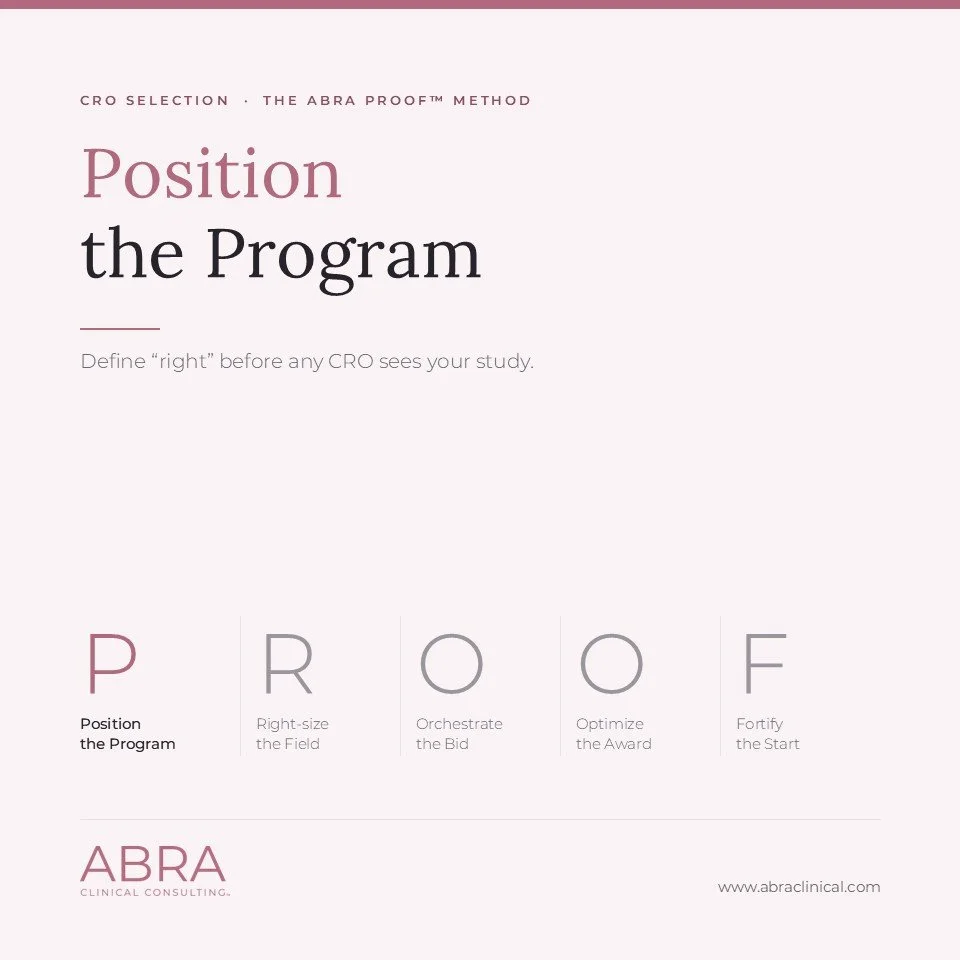
Position the Program: Define "Right" Before Any CRO Sees Your Study
Defining CRO selection criteria starts before you write an RFP. If you do not decide what "right" looks like for your program, the first CRO capability presentation you see will decide it for you. In the ABRA PROOF™ Method, Position the Program is the first stage: we define what "right" looks like before any CRO sees the study, and you sign off the selection criteria before any bid arrives.
I have watched this play out many times. A sponsor takes a few introductory calls, sees an impressive platform demonstration and an elegant therapeutic case study, and begins…

Fractional COO vs. Full-Time Hire: Making the Right Call for Your Clinical Program
When a biotech company begins to move from discovery into clinical development, the leadership needs change quickly. Someone has to translate a scientific plan into an operational one, manage outside partners, and keep spending aligned with the capital runway. Many founders assume the only answer is a full-time Chief Operating Officer. Often, a fractional COO is the better first step.
Consider the math. A full-time COO with…
The Clinical Project Manager Isn't Going Away, but the Job Description Is
AI will not replace clinical project managers, but it is already reshaping what the job requires. The administrative core of the role, meaning tracking, status reporting, meeting minutes and timeline updates, is being automated. What remains is the part that was always hardest: judgment, influence and accountability.
I have hired, developed and led clinical project managers for most of my career. The best ones were…

Three Red Flags in CRO Proposals That Predict Headaches Later
The best-looking proposal is often the least revealing.
A polished deck tells you how well a CRO sells. It doesn't tell you how that CRO will behave halfway through the projected timeline, when enrollment is 40% behind forecast, sites have stopped enrolling, and your data manager just flagged a query backlog you can't explain to your board.
The signals are already there. They're in the language the CRO uses.
Here are three I look for…

Financial Fluency for Clinical Research Leaders
Clinical operations leaders are routinely accountable for budgets they were never taught to read. The result is a predictable pattern: a study runs over, the overage is attributed to enrollment challenges or scope evolution, and nobody can reconstruct which decisions actually caused it.
Financial fluency for a clinical leader does not require accounting expertise, but it does require a working grasp of four things…

Selecting a CRO
A signed CRO contract is not an operating model.
In 25+ years across CRO leadership and helping sponsor operations, I kept seeing the same pattern: brilliant science, a committed team, a carefully chosen CRO…and momentum quietly leaking away because no one had built the operating system around the partnership.
It's never a lack of effort or intelligence. Emerging sponsors are…

Transitioning a Study From One CRO to Another
By the time a sponsor asks whether to change CRO mid-study, the relationship has usually been difficult for longer than anyone has admitted in a governance meeting. The question arrives late, and it arrives loaded.
It deserves a colder answer than it usually gets…
Contracting for AI: Clauses Sponsors Should Add to CRO and Vendor Agreements
Most CRO and clinical vendor contracts say nothing specific about artificial intelligence, even though vendors increasingly use it on sponsor studies. That silence creates risk around data use, accountability and quality. Sponsors should add explicit AI provisions to master services agreements and work orders now, before a problem forces the conversation.
Contract management was a core part of my work across several global CROs. The pattern is consistent: the contract reflects…

Leading Through Risk-Based Quality Management
Risk-based quality management asks clinical leaders to do something genuinely difficult: decide where not to look. A framework that concentrates oversight on the data and processes most critical to participant safety and trial reliability necessarily reduces attention elsewhere. That is why RBQM implementations so often stall.
The stall usually takes a recognizable form. The organization adopts the framework, builds the risk assessment, defines key risk indicators, configures the platform, and then continues monitoring everything at close to the previous intensity because…
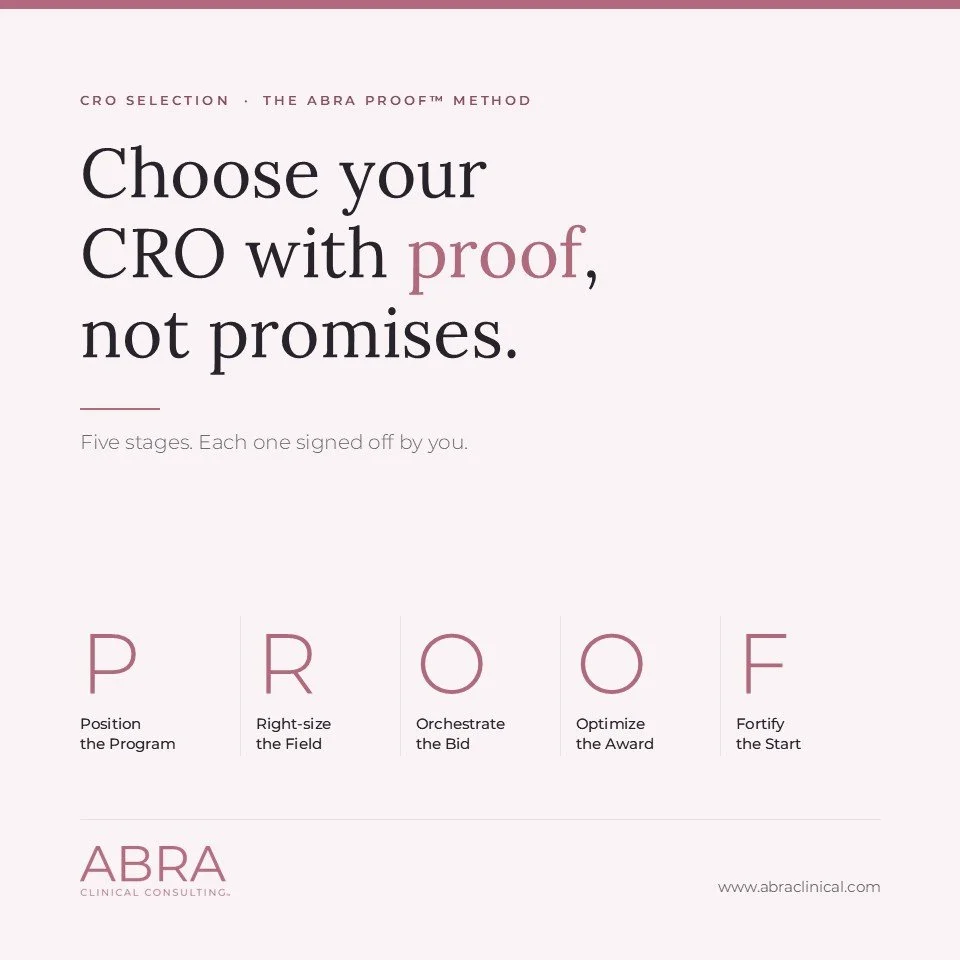
Choose Your CRO With PROOF™, Not Promises
Choosing a CRO is one of the most consequential decisions an emerging sponsor makes, and it deserves evidence rather than a polished pitch. The ABRA PROOF™ Method is a five-stage, principal-led process that takes biotech and emerging biopharma sponsors from first requirements to a contract-ready award by the end of Week 12, then through the first 90 days of the study. Each stage ends in a proof point you review and sign off before the next one begins.
I have spent more than 25 years on both sides of the CRO relationship and…
ICH E6(R3) and AI: What "Fit for Purpose" Really Means for Computerized Systems
ICH E6(R3) does not name artificial intelligence specifically, but its principles apply directly to any AI tool used in a clinical trial. The guideline asks that computerized systems be fit for purpose, validated in proportion to risk, and governed so that data integrity and participant safety are protected. For AI, that standard is both flexible and demanding.
The revised guideline, adopted by ICH in January 2025 and now being implemented by…