
Blog
The Oversight

Inspection Readiness in a Global Industry
Every CRO bid defense has a moment when someone should close the slide deck.
Instead of scrolling through another 30 slides, give the CRO a real scenario:
A monitor reports several unusual deviations. The local team sees isolated events. The global data suggests the beginning of a pattern. The sponsor has heard none of it.
What happens next?
Vendor Selection as a Leadership Decision
In many emerging biotech companies, CRO selection is treated as a procurement exercise. Proposals are collected, costs are compared, and the lowest credible bid wins. That approach misses the point. Choosing a CRO or major clinical vendor is one of the most consequential decisions a sponsor will make, and it deserves executive ownership.
The reason is simple. Your CRO will…
The Best Time to Prepare for Change is Before the Bid Defense
The best time to prepare for regulatory change is before the CRO bid defense.
At the end of September, I wrote about FDA’s Expedited IND Pilot and its ambition to hasten first-in-human development.
Now, the 2026 Unified Agenda adds another chapter to that story.
FDA is considering changes intended to modernize and streamline Phase 1 IND requirements, including…
Interim Clinical Operations Leadership: Keeping Programs Moving During Transition
Leadership transitions happen at inconvenient times. A VP of Clinical Operations leaves in the middle of enrollment. A head of development moves on just as a pivotal study is being planned. An acquisition reshuffles the organization chart. In each case, the program cannot pause while the company searches for a replacement.
Interim clinical operations leadership fills that space. An interim leader steps in with the authority to…
The Bid Defense Is an Audition. Make Sure the Right People Are Auditioning.
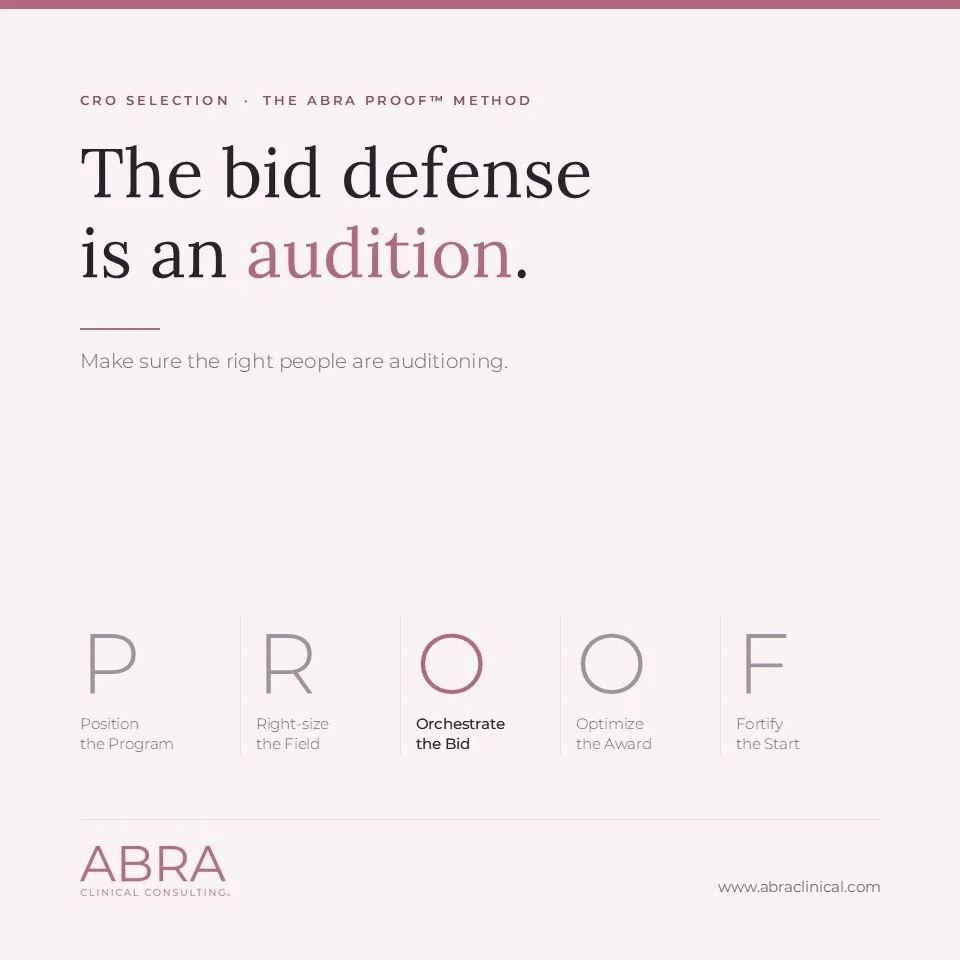
A CRO bid defense should test the people who will run your study, not only the people who sell it. The meeting is most valuable when the proposed project lead and functional leads are in the room, answering study-specific questions in their own words. In the ABRA PROOF™ Method, this is the second half of Orchestrate the Bid: every promise is tested with the team that would actually run your study, so every commitment becomes verifiable.
Most bid defenses follow a familiar script…
Budgets, Change Orders and AI: Can Machine Learning Fix Clinical Trial Cost Overruns?
AI can improve clinical trial budget forecasting by predicting cost drivers, detecting early signs of overrun and analyzing change order patterns. It cannot fix the root cause of most overruns, which is a gap between what was proposed, what was contracted and what the study actually needed.
Few topics generate more tension between sponsors and CROs than change orders. Sponsors feel surprised. CROs feel the scope was never…
Building a Clinical Development Strategy That Your Board Can Trust
Boards of emerging biotech companies want two things from a clinical development strategy: a clear path to value-creating data and confidence that the plan can be executed within the available capital. Too often, the strategy presented is strong on science and thin on operational reality. That disconnect erodes trust quickly once the first timeline slips.
A trustworthy clinical development strategy begins with…
AI On the Mind
AI is the topic on everyone's mind these days.
Every prospective customer asks about it. Every CRO has an AI story. Every capabilities deck seems to promise faster timelines, smarter risk detection, more efficient monitoring, better site support, and fewer manual tasks.
And to be clear, there is a lot of value in many of those applications. But a sizeable amount of the AI currently in use remains at the surface…
Small Biotech, Big Tools: How Emerging Sponsors Should Sequence AI Adoption
Emerging biotech sponsors should adopt AI in clinical operations in a deliberate sequence: first govern what vendors already use, then add low-risk productivity tools, then invest in targeted analytics tied to specific program risks. Trying to do everything at once usually produces expensive software and little change.
Small sponsors face a particular version of the AI question. They lack large internal teams, so they rely heavily on CROs and vendors. They are under pressure from…
Executive Presence for Clinical Operations Leaders
Clinical operations leaders often reach a ceiling that has nothing to do with their operational capability. They run studies well, manage vendors competently, and deliver on commitments, and they are still not in the conversations where program direction is set. The usual diagnosis is executive presence, delivered vaguely enough to be unactionable.
The underlying issue is usually…
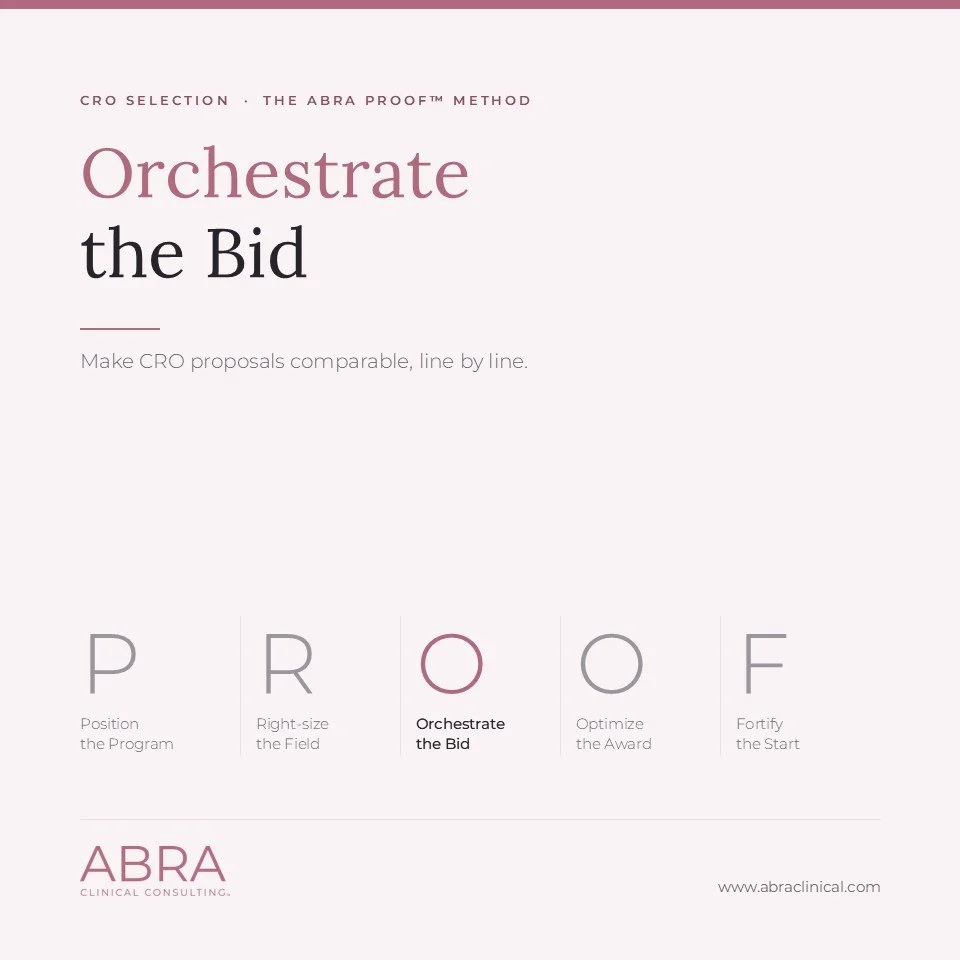
Orchestrate the Bid: Making CRO Proposals Comparable Line by Line
CRO proposals cannot be compared on their totals alone, because each one is built on its own assumptions about sites, enrollment rates, visit counts, monitoring intensity and study duration. To compare CRO bids fairly, sponsors first have to make those assumptions visible and consistent. In the ABRA PROOF™ Method, this is the heart of the third stage, Orchestrate the Bid: every proposal becomes comparable line by line before anyone judges which is best.
The most common moment of false confidence in CRO selection is…
The Executive's Role in CRO Oversight Under ICH E6(R3)
Sponsors have always been responsible for the trials they fund, even when a CRO performs most of the work. ICH E6(R3) makes that responsibility more explicit and more demanding. The updated guideline emphasizes quality by design, proportionate risk management, and meaningful oversight of every party involved in trial conduct. For executive leaders, this is so much more than a compliance footnote. It is a governance obligation.
Under E6(R3), sponsors are expected to…
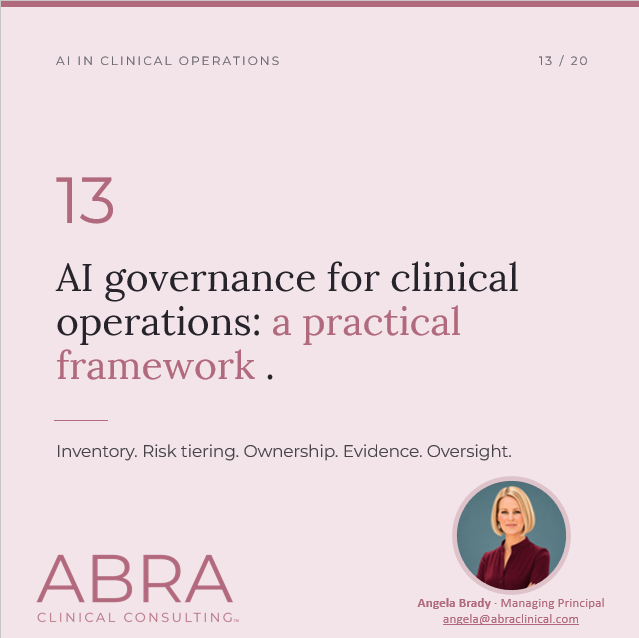
AI Governance for Clinical Operations: A Practical Framework for Emerging Biopharma
AI governance in clinical operations is the set of decisions, roles and controls that determine which AI tools a sponsor uses, how they are evaluated and who is accountable for their outputs. Emerging biopharma companies need governance scaled to their size. That means a lightweight but real framework, not an enterprise bureaucracy and not nothing.
Most small sponsors I work with are already using AI, often without…
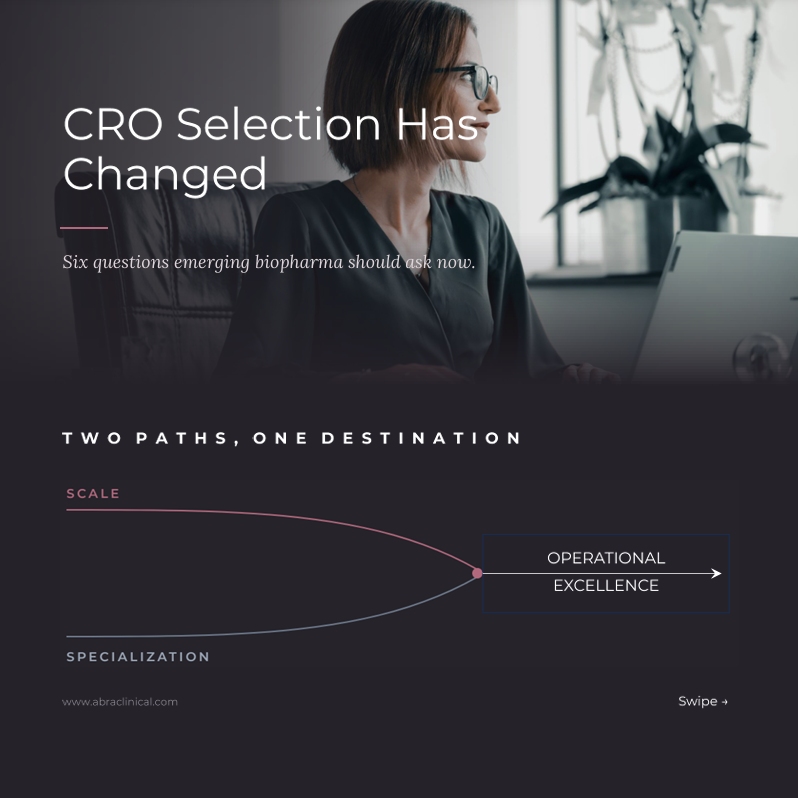
The Evolving CRO Landscape: What Sponsors Should Look For Now
Choosing a CRO is no longer a straightforward decision between the biggest global provider and the smallest specialist.
In today’s market, the more useful question is: Which operating model is most likely to deliver this particular study well, especially when the plan inevitably changes?
Consolidation has created organizations with…
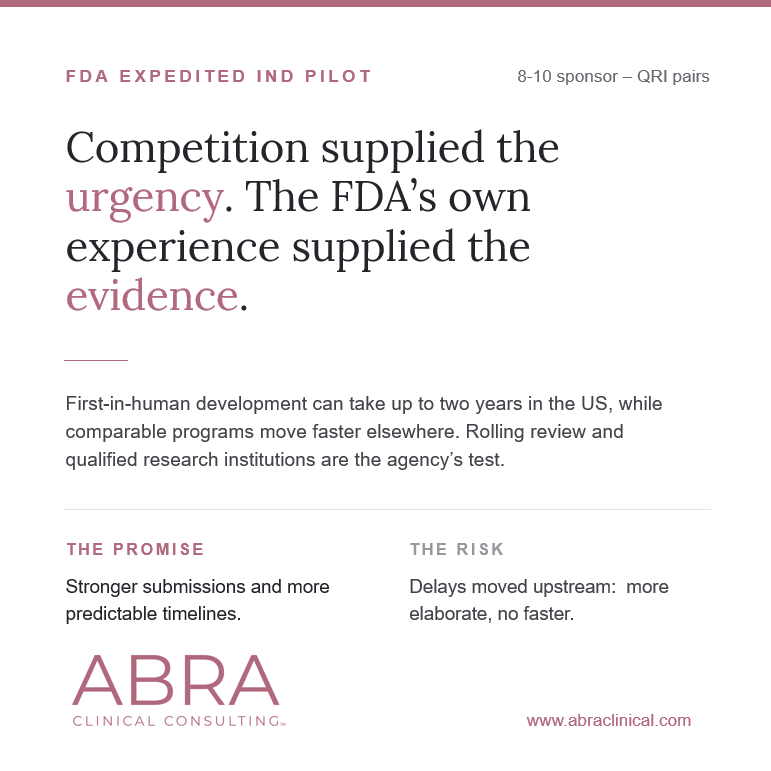
FDA Expedited IND Pilot
FDA launched its Expedited IND Pilot last week. Why? Well, first-in-human development can take up to two years in the United States, while comparable programs move faster in China and Australia.
In short, the FDA is responding to competition by testing whether rolling review and partnerships with qualified research institutions can identify deficiencies earlier, reduce clinical holds, and move studies into humans faster. The agency plans to…
What Changed Between ICH E6(R2) and E6(R3) and What Sponsors Must Do Before January 2027
There is a version of E6(R3) readiness that consists of renumbering SOPs. It is popular because it is a task with an end date. It also misses the point almost entirely.
The revision is not a renaming exercise. It changes where quality work happens, how much oversight a given trial is expected to carry, and — most consequentially for sponsors who outsource — where accountability sits when a vendor gets something wrong. Four changes matter…

Compass, Not Rulebook
For twenty years we ticked the boxes,
monitored every line and page,
source-verified each distant fax
as if our rigor lived in rage…
Designing Protocols That Can Actually Be Run: AI-Assisted Protocol Optimization
AI-assisted protocol design helps sponsors test feasibility before a trial begins, by modeling how eligibility criteria affect the patient pool, estimating site and participant burden and comparing designs against historical studies. Its greatest value is catching operational problems while they are still cheap to fix.
Protocol amendments are one of the most expensive and avoidable problems in clinical development. Research from the Tufts Center for the Study of Drug Development has shown…
Psychological Safety and Data Quality Are the Same Problem
Data quality in clinical research is usually framed as a systems and training issue. Better edit checks, clearer CRF completion guidelines, more thorough site training. All of that helps, but none of it addresses the largest single source of data problems, which is people declining to report what actually happened.
A coordinator who enters a visit date that is technically out of window and expects a difficult conversation has an incentive to record it differently. A monitor who finds a significant deviation late in a study, in a site they have signed off on repeatedly, has an incentive to classify it conservatively. A CRO functional lead who discovers…
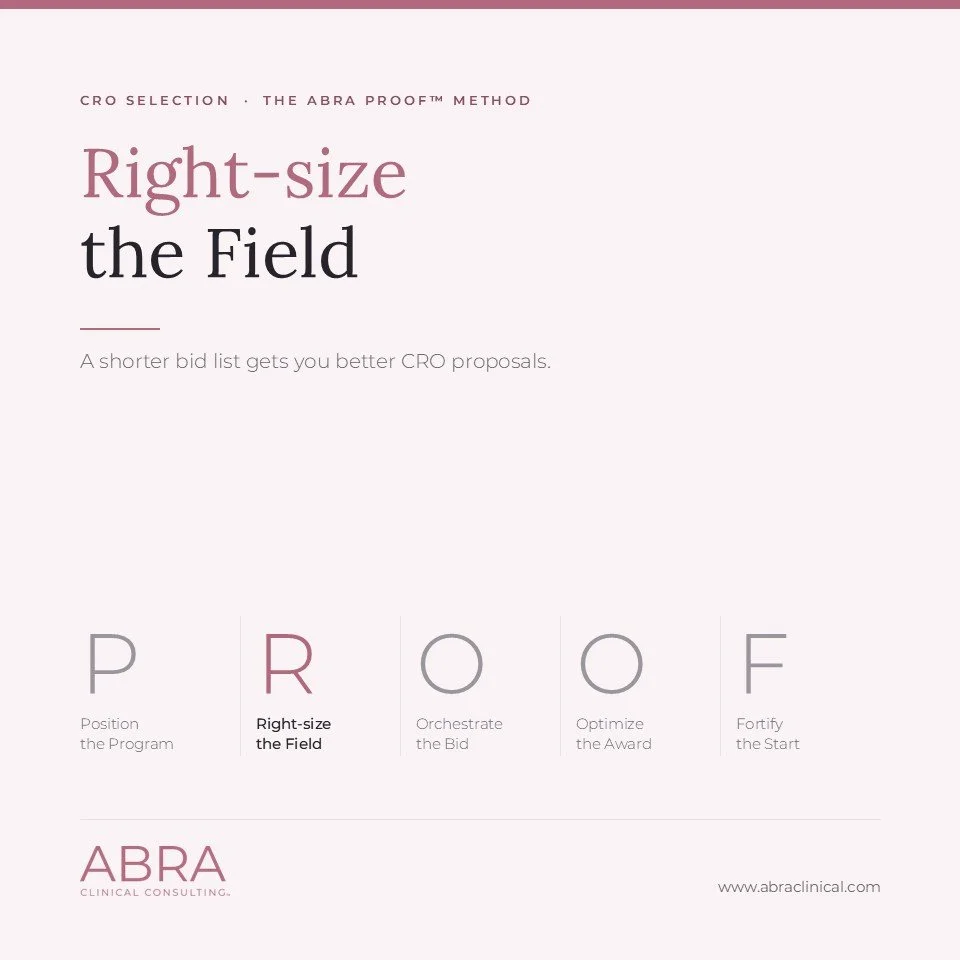
Right-size the Field: Why a Shorter Bid List Gets You Better CRO Proposals
How many CROs should you invite to bid? For most emerging biotech studies, fewer than you think. A right-sized bid list of CROs that can genuinely win on fit produces stronger proposals, more senior attention and a clearer decision than a long list assembled to feel thorough. In the ABRA PROOF™ Method, this is the second stage, Right-size the Field: we invite only the CROs that can genuinely win on fit, not on reputation alone.
Long bid lists are usually a symptom of uncertainty…